Science First
Every core feature traces back to published research: Skinner (1958), Lindsley (1967), Binder (1996), Pavlik & Anderson (2008), Ye et al. (2022). The sources are on our research page.
Case Study
How a 2010 UNT Outstanding Undergraduate in Applied Behavior Analysis, a signed copy of Don't Shoot the Dog, and 14 years of operant principles became an app that makes BCBA exam prep feel designed by someone who lived it.
Watch the story
Every version built on the last: science, community, and one stubborn belief that exam prep could be better.
v0.0 · Dec 20, 2006 · Grayson County College
Before UNT, I finished an associate's degree at Grayson County College.

v0.1 · 2008 – 2010 · Denton, TX
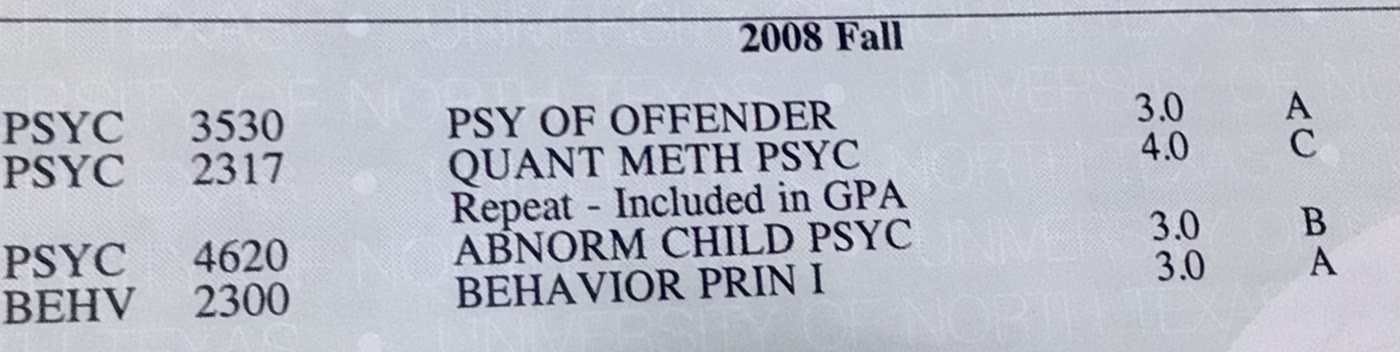
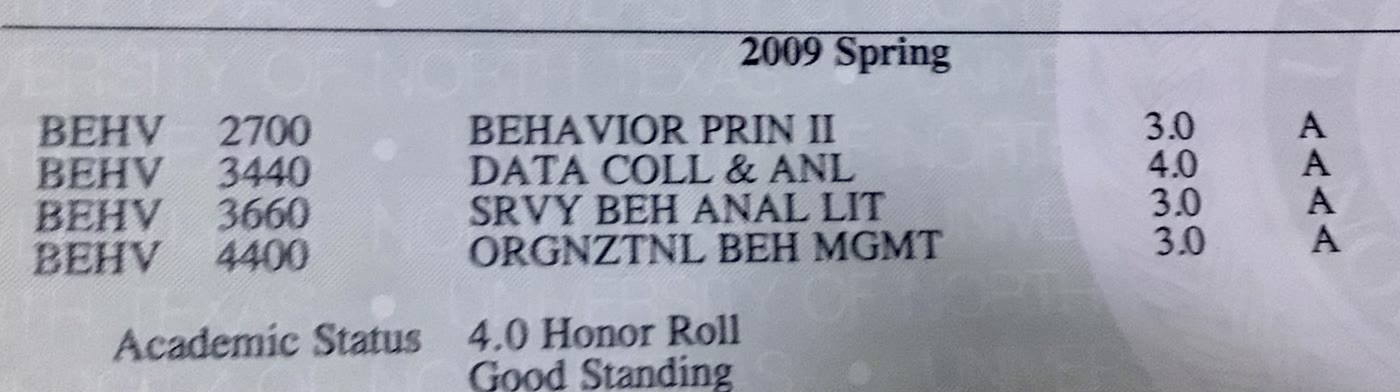
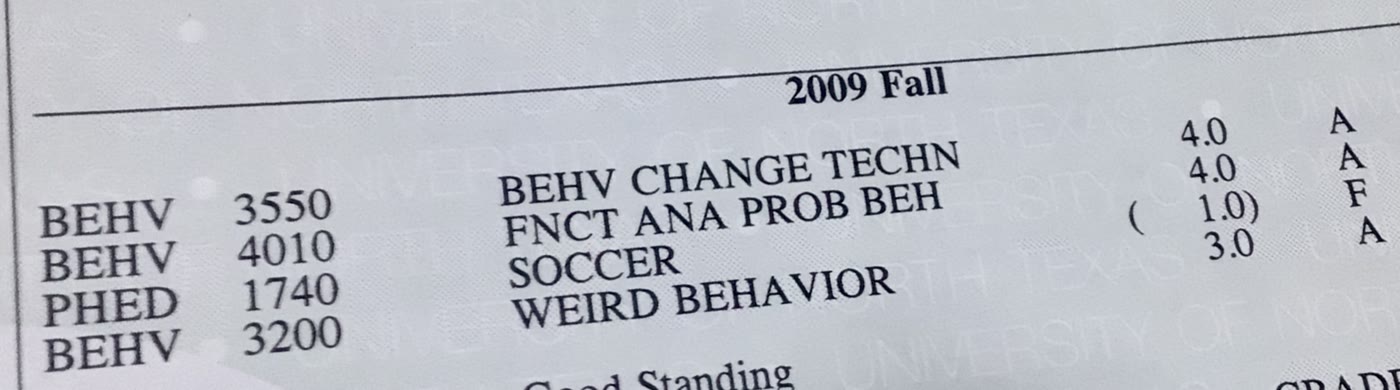
I started in the Applied Behavior Analysis program at the University of North Texas in 2008. One of my professors was Dr. Manish Vaidya. Here is the coursework as it happened, semester by semester, straight from my transcript: the F's and the 4.0 honor roll alike.

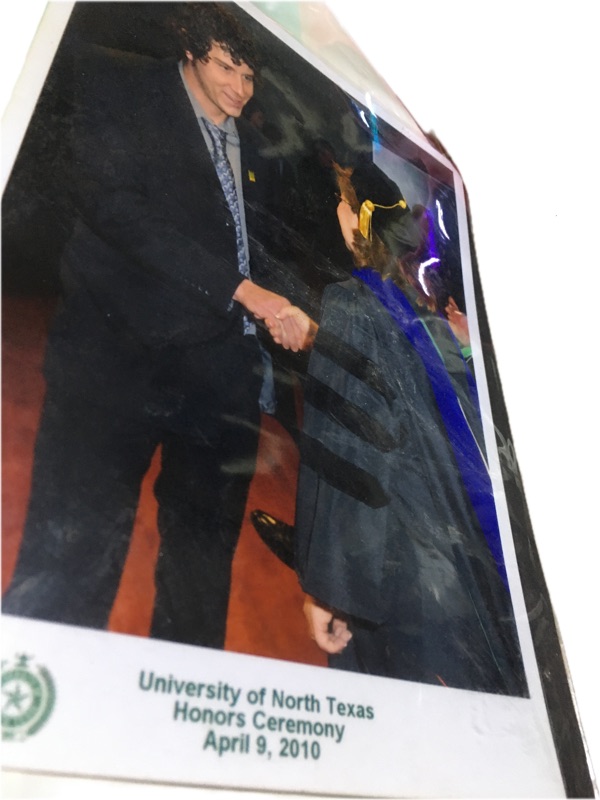
v0.2 · Apr 9, 2010 · UNT Honors Day
At the UNT Honors Ceremony I received the Outstanding Undergraduate Student in Applied Behavior Analysis Award from the College of Public Affairs and Community Service.

A signed copy of Karen Pryor's Don't Shoot the Dog became a north star. Not for “positive thinking,” but for the precision of event marking: the click marks the exact moment of the correct behavior and bridges the delay to the reinforcer.
“The clicker isn't a feature. It's the brand operating at the level of the science it teaches.”
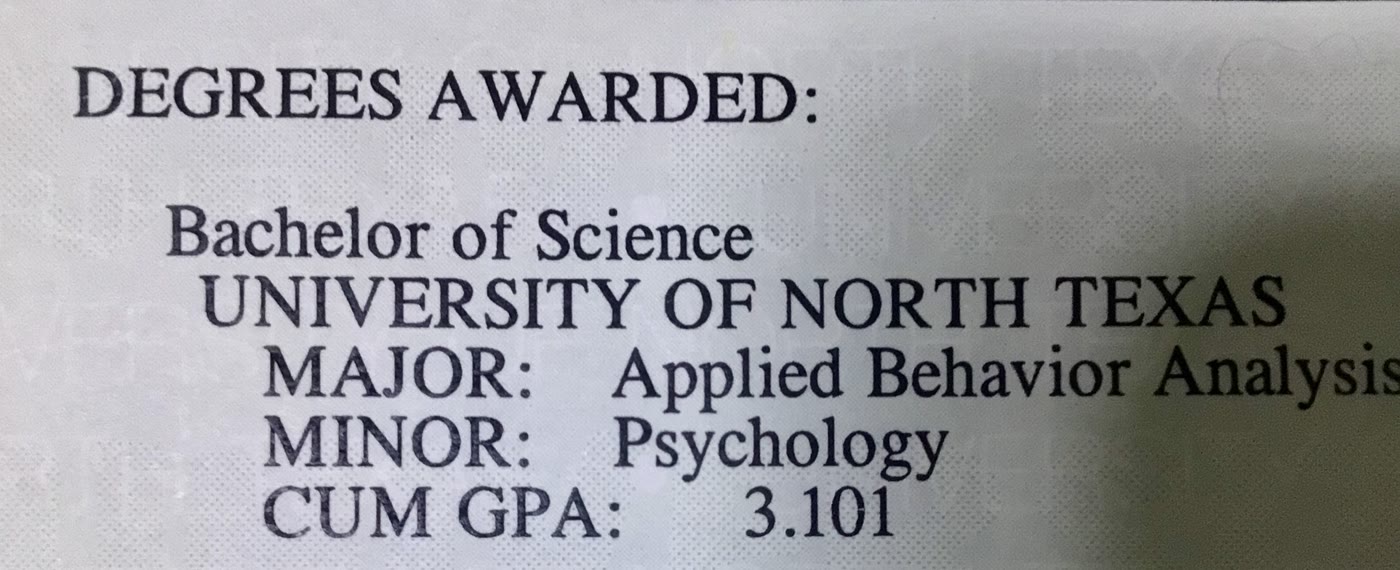
That spring I graduated: Bachelor of Science, major in Applied Behavior Analysis, minor in Psychology.
v0.3 · 2010 – 2024 · 14 Years in the Field
Precision teaching, fluency-based instruction and the Standard Celeration Chart became daily tools, not just things I studied for the exam. Meanwhile the gap between what the science knows and what exam-prep tools offer kept growing: flashcards with timers, multiple-choice banks, and few that used the science they taught.
v0.4 · 2025 · The Idea Takes Shape
Not flashcards with a timer, but real precision teaching: SAFMEDS-style timings, a Standard Celeration Chart, spaced review via FSRS-ABA, and programmed instruction with prompts that fade through four levels from full prompt to independent.
v0.5 · 2026 · Color Paired with Correct Answers
Research on stimulus preference and conditioned reinforcement shaped the feedback design. Picking your colors (your vibe) works as a quick preference check, and the app then pairs those colors with correct answers and streaks. A stimulus reliably paired with reinforcement can come to function as a conditioned reinforcer; whether it does for you is a question for your data, not our design. That makes the palette a behavioral choice, not just a design one.
v0.6 · 2026 · The Clicker Connection
Karen Pryor's clicker-training principle, an event marker that bridges the exact moment of correct behavior and the reinforcer, shapes the app's feedback: instant right-or-wrong marking on every answer, a spring bounce when your streak grows, and a clicker that lights up when today's goal is met. The .click name isn't a gimmick. It's the brand operating at the level of the science it teaches.
v0.7 · 2026 · A Real Standard Celeration Chart
Your best SAFMEDS timing each day goes on a daily per-minute Standard Celeration Chart, the chart Ogden Lindsley designed: 140 calendar days, six logarithmic cycles, corrects as dots, errors as ×'s, and celeration lines showing your learning per week. Switch between digital precision and hand-drawn texture.
v0.8 · 2026 · Every Task, Three Frames
Every task in the BCBA (104), BCaBA (90) and RBT (43) test content outlines is covered by three programmed-instruction frames with 4-level prompt fading: 711 frames in total. AI-assisted and machine-checked against the outlines and cited sources; not yet BCBA-reviewed.
v0.9 · 2026 · Honor System: Exam Failure Discount
If you've failed your exam using other study methods, we honor that. It's an honor system: you certify your attempts under your professional integrity. One failure gets a one-time 50% discount (SC50), applied at checkout. Two or more failures get free lifetime access after a quick owner review. No interrogation, no judgment. Claim it in the app.
v1.0 · Now · Behavior Celeration .CLICK!
Built with rigor at every level, from the UNT foundation to the deployment on Hostinger. This is where precision teaching meets modern web tech. The app is ready and the science is sound. The only question left: are you ready to click?
— Corey Lee Sargent
What drives the work
Every core feature traces back to published research: Skinner (1958), Lindsley (1967), Binder (1996), Pavlik & Anderson (2008), Ye et al. (2022). The sources are on our research page.
Honor-system discounts, transparent pricing, and a product that treats every user as a professional, not a conversion metric. Your data runs the app and nothing else.
The clicker isn't a feature; it's the brand. Color isn't decoration: paired with correct answers, it can work as a conditioned reinforcer. The .click domain seals it.
Precision teaching, colors paired with correct answers and clicker feedback, built for the exam you're studying for.
Click Now! →